

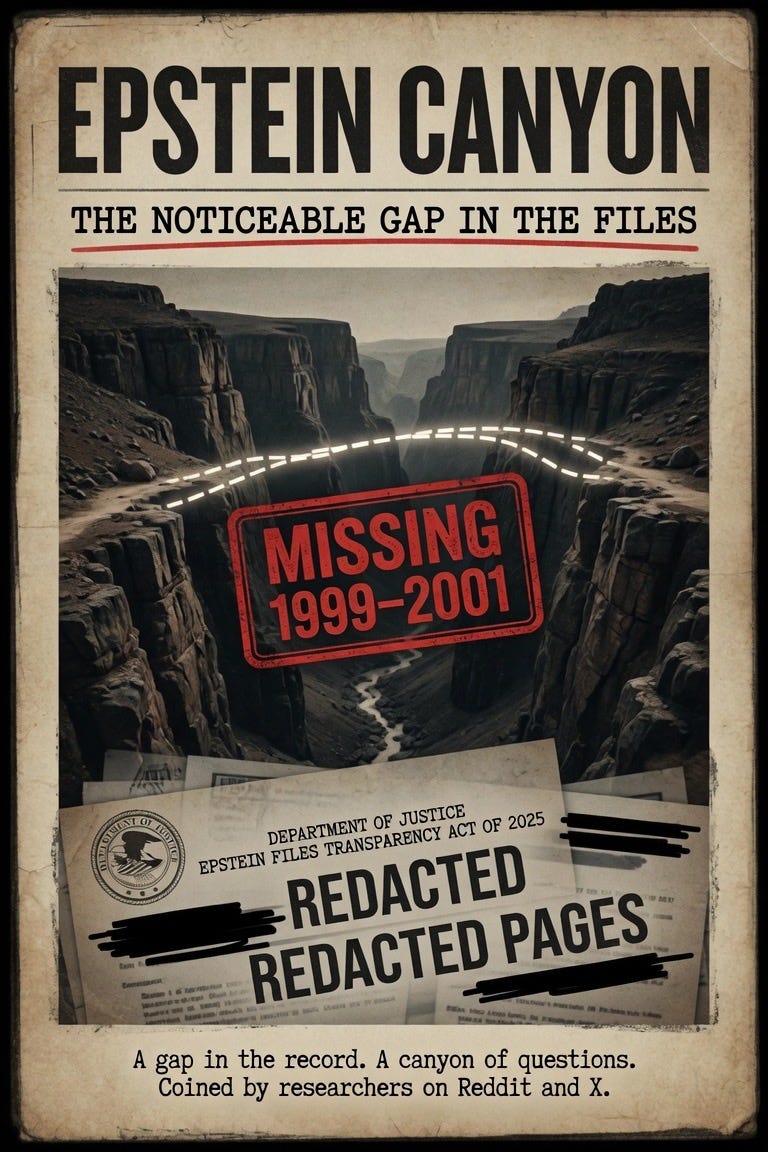
The term “Epstein Canyon” refers to a noticeable gap or discontinuity in the Jeffrey Epstein files released by the Department of Justice under the Epstein Files Transparency Act of 2025. Online researchers, particularly on Reddit and X, coined the phrase after spotting what looks like missing records specifically covering the years 1999 through 2001.
What Is the Epstein Canyon?
When the DOJ released millions of pages in waves through early 2026, independent analysts began examining the datasets for patterns. They found irregularities in serial numbering and document density during this three-year window — right before the 2005 Florida investigation into Epstein began in earnest.
Key observations include:
Large jumps in EFTA serial numbers in certain datasets, with one reported gap of roughly 25,000 serial placeholders.
A drop-off in chronological density of records.
Email caches that appear to start later than expected — Ghislaine Maxwell’s emails reportedly begin in late 2001, and Epstein’s main Yahoo account activity picks up in 2002.
This period was a busy time for Epstein. He was traveling extensively, expanding his financial network, and his social circle of powerful figures was active. The timing also overlaps with the run-up to and immediate aftermath of the September 11, 2001 attacks, which has led to online speculation about possible intelligence connections or withheld material tied to larger events.
The Epstein Files Transparency Act and the Numbers
Congress passed the Epstein Files Transparency Act (EFTA) in November 2025 to force the release of all unclassified DOJ records related to Epstein. The law required a full public dump within 30 days.
Instead, the DOJ released materials in batches, ultimately claiming to have published about 3.5 million pages, plus videos and images. However, the department had identified over 6 million potentially responsive pages. The difference — roughly 2.5 million pages — was attributed to duplicates, non-responsive material, victim privacy protections, and various legal privileges.
Critics, including some lawmakers, questioned whether the withheld material was being properly justified. The “canyon” became a focal point for those who believe the gaps are too clean and conveniently placed to be random.
Official DOJ Position vs. Public Skepticism
The Justice Department maintains that it complied with the law. It says unreleased or redacted material falls under legitimate categories: protecting victims, attorney-client privilege, deliberative process, or national security where applicable. They have not specifically addressed the “Epstein Canyon” by name in official statements.
Independent reviewers have pointed out that some early claims about the exact size of the gaps may have been overstated due to AI-assisted analysis that later required corrections. Still, the later start dates for certain email records and inconsistencies in serial numbering remain points of discussion.
Why the Epstein Canyon Matters
For many following the case, the gap raises basic questions about completeness and transparency. Epstein’s activities in the late 1990s and early 2000s are known to have been intense, making the relative scarcity of records from that window stand out. Whether the canyon represents routine administrative filtering, deliberate withholding, or simply messy record-keeping is still debated.
The files remain publicly available on the DOJ’s Epstein Library site for anyone who wants to examine them directly.
The Epstein Canyon is a real observation about discontinuities in the released data — particularly around 1999-2001 — but its significance is still unsettled. Some see it as evidence of a cover-up; others see bureaucratic reality in a massive document production. The debate continues as researchers dig through the millions of pages that were released.